

Ten years, and tens of millions of beneficiaries: the openIMIS community celebrates a decade
© GIZ/Umong Shahi
An open source software for managing health and social protection programs, openIMIS is powered by an active community of practitioners. In June 2026, this community came together in Kathmandu, Nepal, to celebrate the successes of the first decade, reflect on common challenges, and look to the future.
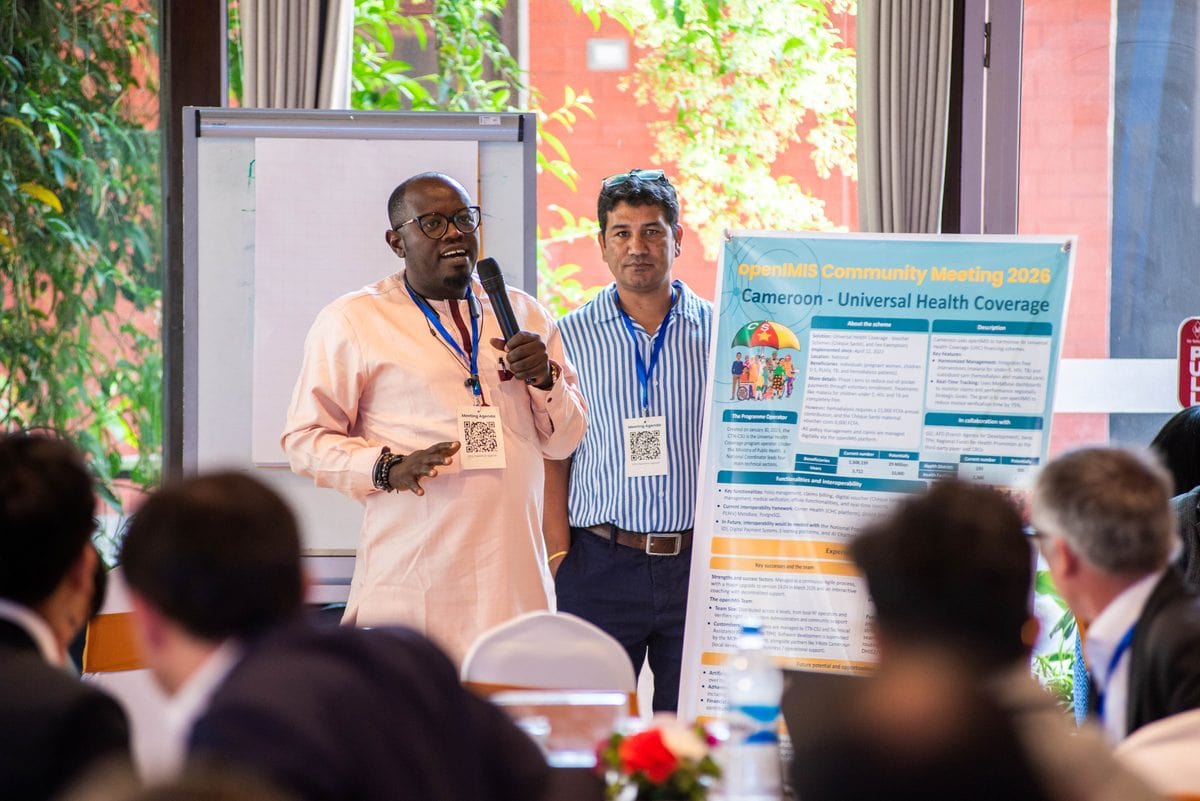
Fifteen years ago, George Atohmbom Yuh was in charge of operations for a micro health insurance program in Cameroon, which had started out relying on manual processes. ‘We had warehouses full of paper justifications,’ he recalls. ‘This became very challenging as the program grew.’
The team set about creating a digital solution for managing these complex operations. Building a software product that met all of their needs, however, proved difficult. After some research, they came across a similar program in Tanzania for which a tool had recently been developed with the support of the Swiss Agency for Development and Cooperation (SDC). ‘We wrote to them and asked, and they agreed we could use it licence-free, as long as we customised it ourselves,’ says George Atohmbom Yuh.
When this same digital tool – then known as IMIS – was also adapted for use in Nepal with the support of the German Federal Ministry for Economic Cooperation and Development (BMZ), it was becoming clear that many countries had a need for something equivalent to manage the processes involved in running a health insurance program. The idea was developed to make the IMIS software a freely available product that could be customised for use anywhere. Thus, in 2016, IMIS became openIMIS, an open source software – free to download and tailor to specific needs – and the openIMIS Initiative, a collaboration between SDC and BMZ, was established. At the same time, a community of users, implementers, and software developers working on and with openIMIS was formed.
George Atohmbom Yuh attended one of the earliest meetings of this small, newly created community in Germany in 2016. ‘In a workshop, they asked everyone to write a sentence about openIMIS,’ he remembers. ‘I wrote, “openIMIS, the future of health insurance,” because I knew what we went through to get a tool that worked.’ The existence of openIMIS, he hoped, would mean fewer programs would have to go through the struggle of finding a suitable system.
Ten years on, in June 2026, George Atohmbom Yuh is reflecting on this hope at the openIMIS Community Meeting in Kathmandu, Nepal, which he attended in his current capacity as an openIMIS consultant, and team lead in knowledge management and capacity building. openIMIS has now been implemented in more than fourteen countries to manage programs covering more than 39.4 million beneficiaries. New implementations have customized and added features according to their program’s needs, subsequently contributing these innovations back to the community. As such the tool’s functionality and use cases have grown; openIMIS is used to manage not only health insurance but a range of social protection programs as well.
At the 2026 meeting, the ever-growing community of developers, implementers, governments, academics, and policy experts working on and with openIMIS came together to share experiences and innovations from the past decade, to consider the common challenges many implementations face, and to discuss the potential future of the software and the community that surrounds it.
© GIZ/Umong Shahi, Ajay Shrestha
Ten years of openIMIS in Nepal
The Community Meeting provided an opportunity for reflection on the largest and one of the longest running openIMIS implementations, in its very own location of Nepal. For a decade, the Health Insurance Board of Nepal has been using openIMIS to manage the processes of the National Health Insurance Scheme, which now insures over 7 million people across all 77 of the country’s districts, working with over 500 health service providers. openIMIS has been employed to digitalise much of what was previously a scattered, paper-based process. ‘Today, from enrolment to claims management and report generation, we can do everything with openIMIS,’ said Pawan Sah, chief of the claim management and planning policy section at the Health Insurance Board, in a panel session on Nepal’s openIMIS experience. ‘This has improved efficiency, transparency, accountability and access to the data for decision making.’
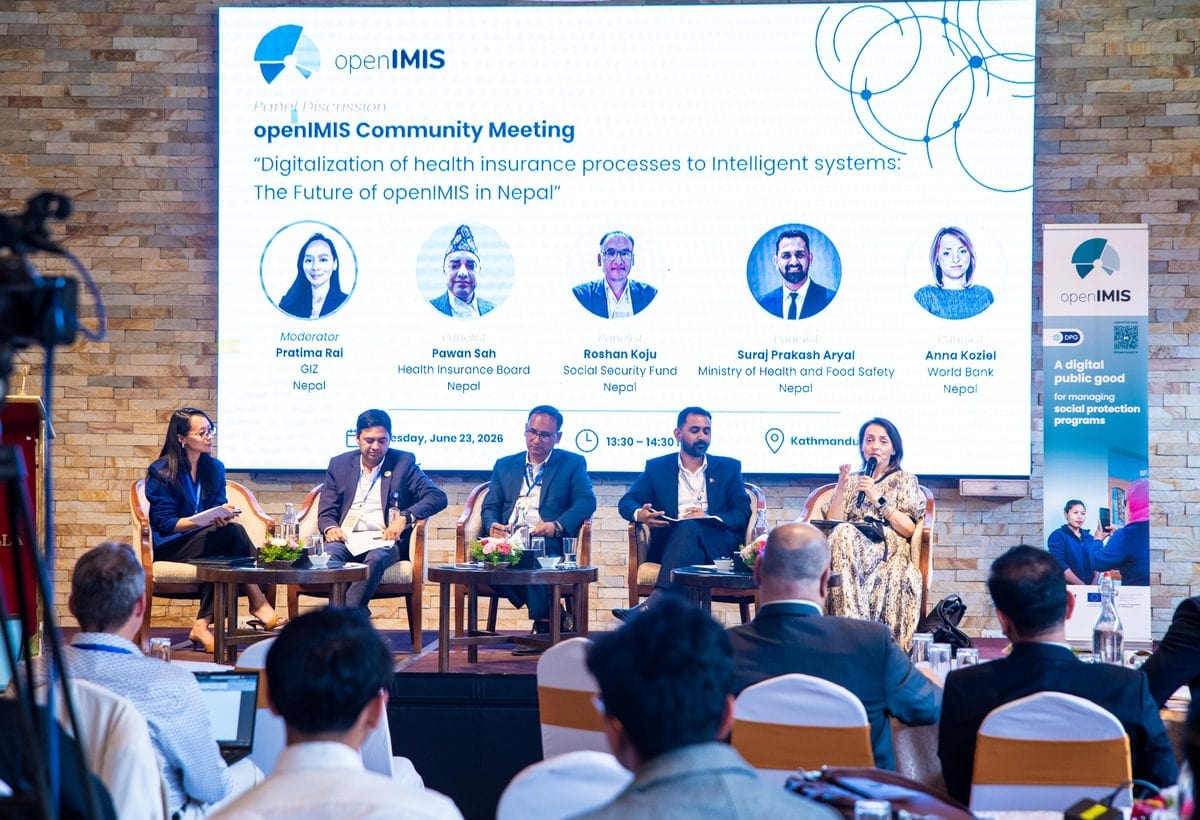
In addition, Nepal’s Social Security Fund has been using openIMIS since 2020 to manage some processes involved in a separate insurance program, primarily for the country’s formal-sector workers. The fact that openIMIS is interoperable with other systems like Electronic Medical Record systems (EMR) and the program’s existing payment system, combined with the efficiency and accuracy it has enabled, has helped the Social Security Fund to build a positive reputation and develop trust among hospitals and healthcare providers. These key stakeholders are increasingly recognizing that the Fund’s software is easy to connect to existing systems, that claims they send are processed quickly, and that reimbursements are timely. ‘Once, we were visiting hospitals door-to-door to ask them to accept our program. Now the situation has reversed. Hospitals are coming to our office, eager to join,’ says Roshan Koju, director of the information management division at the Social Security Fund.
No program is without its challenges. A key difficulty cited by Pawan Sah of the Health Insurance Board is one which will be familiar to openIMIS implementers in many other contexts: coordination between the many different individuals and institutions involved in the process of managing a program. ‘Digital transformation is not only about technology,’ he pointed out. ‘Its success depends on leadership, governance, business processes, trained staff, and continuous user support.’
For the Social Security Fund, a key lesson has been the importance of developing the capacities and skills of those using the system. A lack of literacy in the software can lead to incomplete medical claim documents, which ultimately affects the quality of data used to inform decisions. ‘We haven’t been able to do enough yet to train contributors, hospitals, employers, even users inside our own organisation,’ Roshan Koju reflected. Another key challenge has been the cost of storing the huge amounts of data involved in running the program.
More implementations, more functionality, more shared knowledge
When Nepal’s Health Insurance Board first implemented openIMIS ten years previously, the software had less functionality and fewer features than it does today. Because openIMIS is modular and open source, innovations from different implementations can be added to the global version of the software, and become available to be used elsewhere. Teams in Tanzania, Cameroon, and Nepal have been key contributors to growing the software’s functionality. ‘Throughout our experience in the field, we started to innovate,’ says Purushottam Sapkota, advisor in ICT and digitalization at the GIZ Support to the Health Sector Strategy II in Nepal. ‘When we showcase our innovations to other countries, and they use them, that’s a proud moment for us.’
Implementations both benefit from the contributions of others to the openIMIS software, and make significant contributions themselves. In Burundi, the CORE-MIS solution, powered by openIMIS, is used to manage cash transfer and financing for the Merankabandi (Cash for Jobs) program, an initiative of the Government of Burundi, financed by the World Bank, which has scaled from a four-province pilot to a nationwide program. ‘What allowed us to do this scaling was the foundation we used,’ said Anthony Belem, an information and technology consultant for the World Bank, in a presentation to the Community Meeting. ‘We stood on the shoulders of giants, building on CORE-MIS and openIMIS, and then added our custom requirements.’ The implementation in Burundi has added to and strengthened CORE-MIS/openIMIS functionalities, in particular those that relate to social protection. ‘The wider adoption of this implementation has allowed us to improve existing modules, to discover certain difficulties and to correct them,’ Anthony Belem remarked. ‘As we continue to implement in more countries, the solution becomes even more robust and mature.’
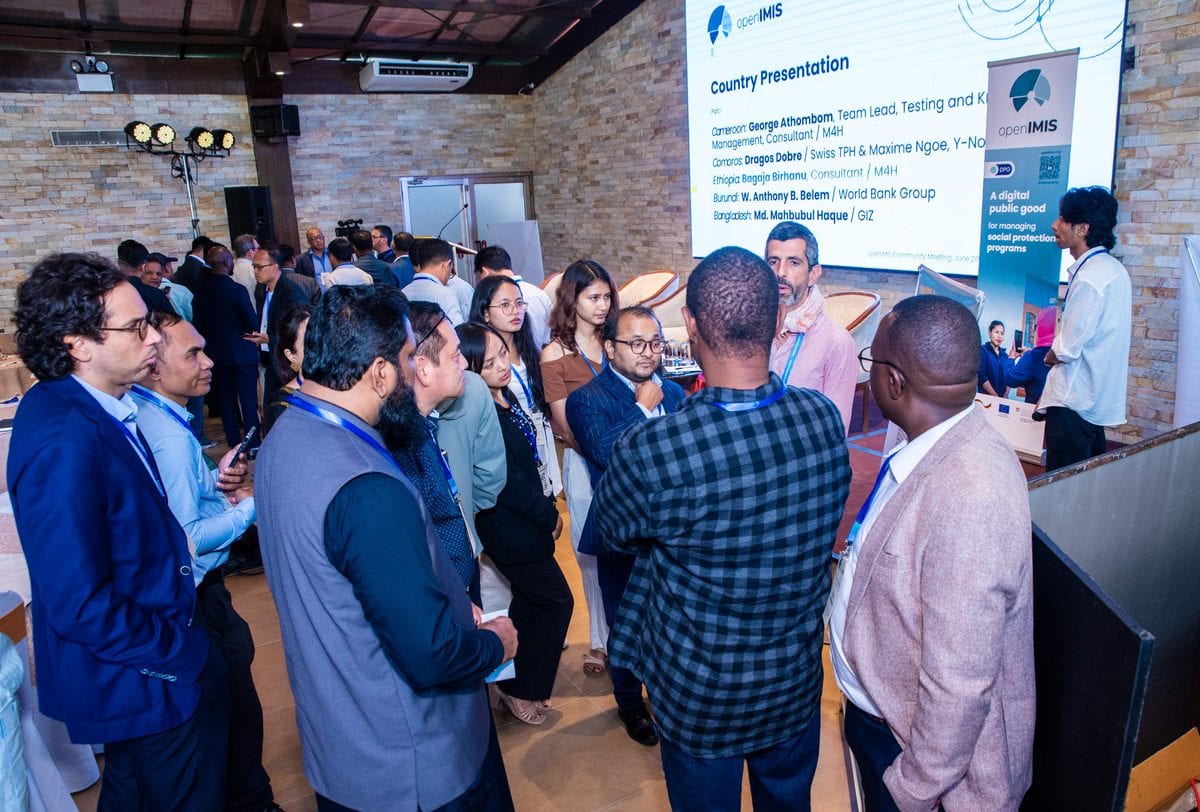
Today, over 14 countries have implemented openIMIS and contributed to the functionality of the tool. At the 2026 Community Meeting, details of implementations in Bangladesh, Cameroon, Comoros, Ethiopia, Lao, and Tanzania were also presented, showcasing just some of the range of uses of openIMIS, the variety of contexts in which it is used, and the diversity of teams working on it.
Coordinating a growing open source platform
With modules added to openIMIS by multiple teams at different times, the management of these contributions becomes increasingly vital, and is an important part of the role of the openIMIS Coordination Desk, hosted at GIZ. In a presentation to the community meeting, Uwe Wahser, ICT expert at the openIMIS Coordination Desk, emphasised the bottom-up, grassroots approach: ‘We had the broad lines of what openIMIS could do, but the details came from the functionalities that were implemented in countries, and fed back to the community. We are unable to give a detailed roadmap for the future, because we don’t know what’s coming in. We provide broad strategic guidelines on things we feel are important, and ensure the proper integration of contributions in regular product releases.’
One such important aspect was the Solution Building Project. As openIMIS matured and was adopted across an increasing number of sectors and use cases, the platform expanded to include a wide range of functionalities. While this breadth of capabilities provides significant flexibility, most implementations need only a subset of these features. Rather than requiring every implementation to adopt the platform in its entirety, which could add unnecessary complexity, a new approach was developed to bundle modules for different use cases. Teams from Swiss TPH and the software company SolDevelo have been working to create such bundles for health insurance, cash transfers, voucher schemes, accident injury insurance, beneficiary registries, and, most recently, AI claims management. ‘The idea is to have these solutions built per use case. When implementers want to test out only specific functionalities for their needs, they can start from a smaller, set bundle of modules. They can try out openIMIS without being overwhelmed by other functionalities they might not need,’ explains Dragos Dobre, project leader and IT system architect at Swiss TPH, and team lead of the Solution Building Project. Each solution consists of only those modules needed for the specific use case, whilst remaining fully customisable.
A growing community of practitioners
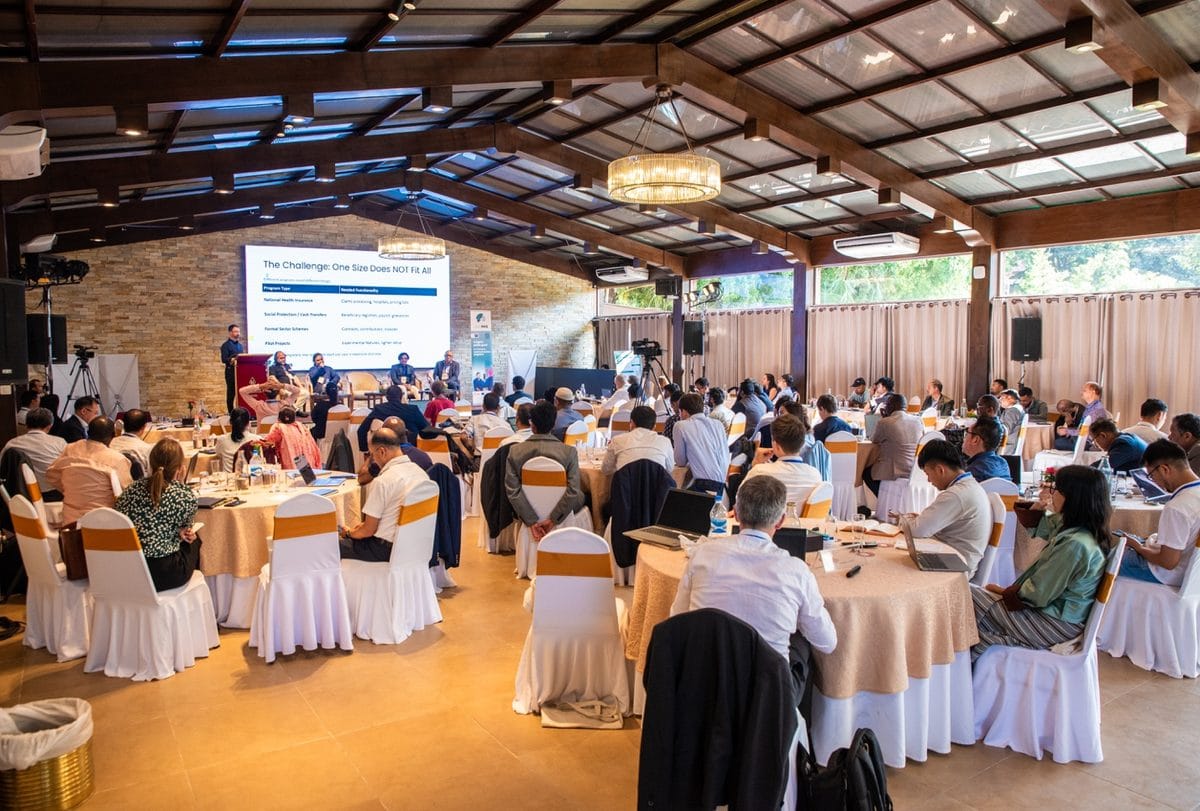
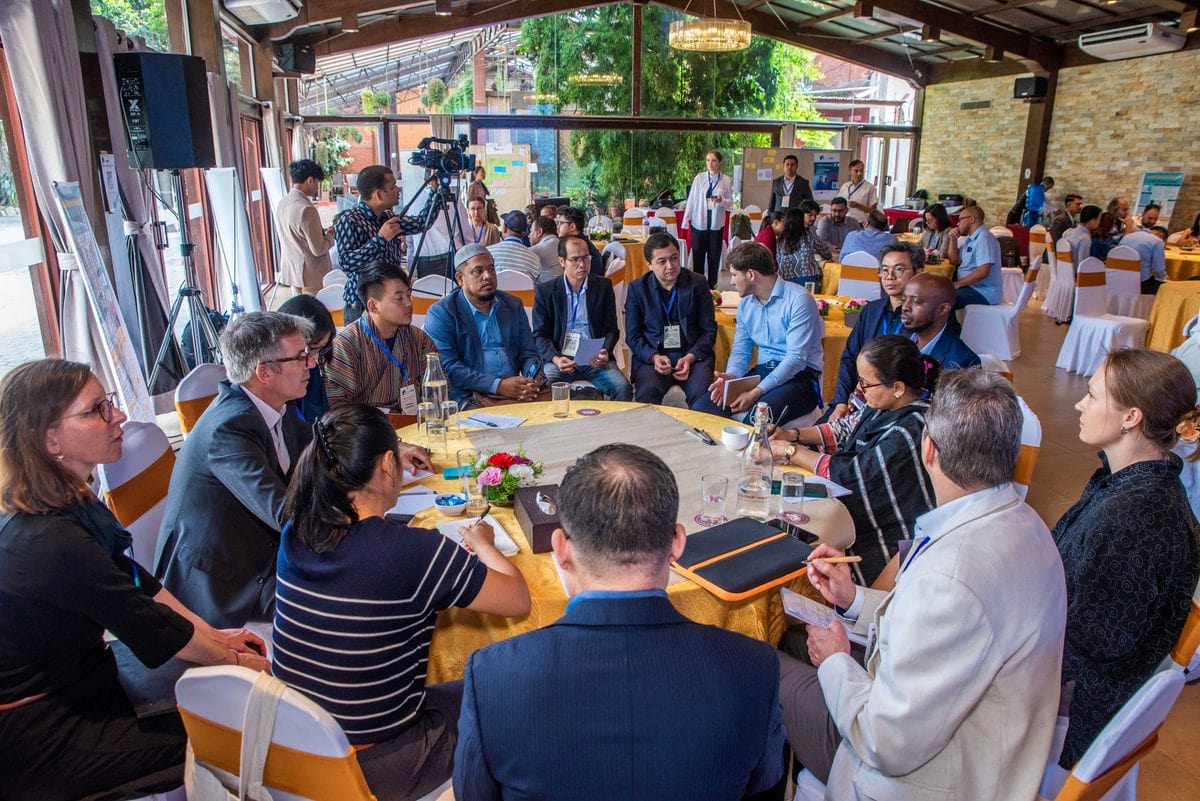
Ask people working with openIMIS – from different contexts, and in different ways – what they see as a key advantage of the software, and one answer comes back again and again: the community surrounding it. Celebrating a decade of openIMIS in Kathmandu was a chance to consider the growth of this community over that period. At the first meeting a decade ago, there were around 10 people in attendance; June 2026 saw more than 120 people from over 20 countries coming together.
Working within an open source community has many practical benefits. ‘The community is really active,’ says Maxime Ngoe, CEO of Cameroon-based software company Y-Note, whose work spans multiple openIMIS implementations in a number of African countries. ‘Every week there are a series of online developers calls to co-ordinate on different aspects of our work. This also gives us plenty of space to discuss challenges. Being able to solve any problems together is a huge advantage.’
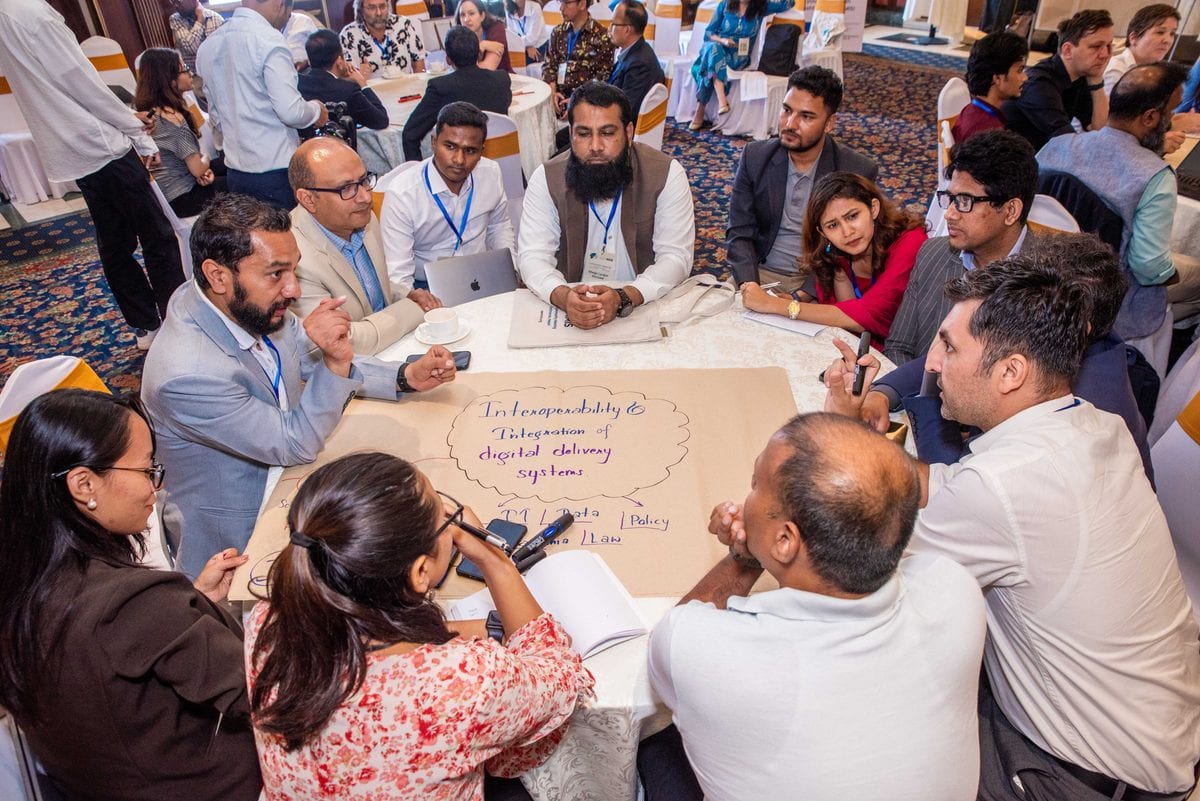
The community around openIMIS is not only about the technical development of the software. It is a space for developers, implementers, policy experts, governments, and partner organisations to share their experiences around the whole process of adapting openIMIS and implementing a social protection program. At the 2026 Community Meeting, for example, a number of challenges were shared by those working on current implementations, many of whom have faced similar hurdles. Among these were the pitfalls of incomplete communication between those writing the policy, those defining program processes, and those developing the software. Also mentioned was the challenge of managing interoperability from both a technical and political point of view, and the expense and complexity of training staff in the use of the software. When these experiences are shared, heard, and recognised, others can learn from them, as well as offer their own ideas and approaches.
As part of this process, we can draw on practical experiences to develop and strengthen more structured approaches to solve challenges more systemically.
Ernesto Brodersohn, coordinator of the Technical Commission on ICT and Organization Management and Innovation from the International Social Security Association (ISSA), a core partnering organisation of the openIMIS Initiative.
Welcoming possible new implementations
Looking to the future, both the openIMIS community and the number of implementations are set to continue growing. The 2026 Community Meeting was attended by teams from, or working with, several countries looking to learn about the software, and possibly to explore it as an option for managing the specific needs of their programs.
‘We were happy to see the experiences of the countries that have presented at the Community Meeting,’ says Khadim Hussain Channa, secretary of the Social Protection Department for the Government of Sindh, Pakistan, where there is potential for openIMIS to be used in a variety of social protection programs. ‘Their success has been the main lesson learned for us.’
‘It’s been invaluable to connect with other implementations,’ said Souphalack Bounpadith, social policy specialist at UNICEF, who works supporting the government to improve and strengthen social protection systems in Lao PDR. ‘Before coming, it was difficult to see where and how to start with digitalisation, but this meeting has been eye-opening in terms of initial steps.’
A potential solution to other challenges
As new countries and organisations consider deploying openIMIS, new use cases are also emerging. One potential being explored is that of disability registries. ‘More and more countries are developing specific benefits for children and adults with disabilities. For that, they need a targeting mechanism, and they develop what we call disability registries,’ explains Alexandre Cote, disability policy and system specialist at UNICEF, who works to support countries developing integrated support for children with disabilities. Given that many countries are taking steps towards similar goals in this area, each developing their own management information system could be an unnecessary duplication of work and a poor use of limited funds. There is consequently a need for a solution that can be available to all these countries whilst remaining fully customisable to their individual needs. As an existing software with proven implementations, supported by a community of practitioners in health and social protection, openIMIS will be well-placed to form the basis for this solution.
Another potential use explored at the Community Meeting was that of adapting openIMIS for the integration of social protection and climate systems. With extreme weather events and climate shocks becoming increasingly frequent around the world, there is a growing need for mechanisms that can quickly deliver financial assistance to those negatively affected on the ground. ‘You need a digital infrastructure in place in order to facilitate this, as well as to target the people who should receive support. This is a vital role that openIMIS could play,’ says Jennifer Phillips, advisor on social protection and climate at GIZ. Employing and customising openIMIS is more time- and cost-effective than building new solutions from scratch – a particularly important advantage in the context of extreme weather events or natural disasters. Given its modular design and interoperability, particular openIMIS functionalities necessary to the context can also be integrated into whatever is already in place. ‘If, for example, a country doesn’t have a cash transfer mechanism already built into their existing system, openIMIS could work with a current social registry system, and provide this extra functionality,’ Jennifer Phillips explains.
Developing functionalities for the future
One key theme of the 2026 Community Meeting was, of course, the potential uses of Artificial Intelligence in openIMIS. Particular attention was paid to the new AI claims solution, developed in cooperation with Swiss TPH, which Nepal’s National Health Insurance Board is actively working towards integrating into its system to improve claims adjudication. The Board receives more than 70,000 insurance claims per day and, with manual claims review processes, has the capacity to review only up to 3,000 per day. Trained on the institution’s own data from the last decade, the new AI module will be able to replicate the repetitive claims review process, and handle tens of thousands of claims in a single second. The AI claims solution can be integrated into existing openIMIS implementations. Furthermore, it is interoperable with other systems, meaning it can be utilised as a standalone model by any other insurance program.
The next ten years and beyond
As the number of implementations, functionalities, and use cases continues to grow, and the community welcomes more new countries and organisations, the future of openIMIS holds opportunities and challenges alike. ‘The diversity of stakeholders is a major asset, but it can be challenging to keep track of work being carried out across parallel initiatives and locations,’ reflects Mathilde Mailfert, technical officer at the International Labour Organization (ILO) and P4H Network Global Focal Point. ‘That’s why events like the Community Meeting are so important. They provide an opportunity for everyone working around openIMIS to come together, exchange experiences, and learn from one another’s perspectives.’
Having a shared vision for the way forward, and steering openIMIS without losing the flexibility of its adaptable, community-driven nature, becomes an increasingly formidable and vital task. ‘A roadmap is helpful, but it can also be somehow inhibiting,’ says Joe Zaarour, digital AI/machine learning social protection advisor at the World Food Programme (WFP). ‘As a community, we have to strike the right balance between remaining nimble but also having a vision for where the openIMIS product could head.’
This balance is also necessary in the current, uncertain context within which the openIMIS community is working. ‘Of course, everyone would want to see something written down that says, “This is what we’re going to do”,’ says Saurav Bhattarai, team leader at openIMIS. ‘But we have to be realistic. We live in uncertain times, especially in the development cooperation space. The joint way forward is to be as flexible as we can, and to be open to collaboration in contributing to the bigger goals we’re all working towards. That’s the work for the community as we go into the next phase of openIMIS.’
Ellen Harris
October 2026