

What if we could act before disaster strikes?
Destruction caused by cloudbursts in Buner, Khyber Pakhtunkhwa, in July 2025 @GIZ
When heavy rain begins to fall in a mountain valley, a family living beside a river does not think about disaster risk reduction.
They think about whether the river will rise.
They think about their children.
They think about the house they built with years of savings, the crops in the fields, the livestock they depend on, and whether there will still be a road to the nearest health facility in the morning.
For a family already living close to poverty, a disaster can mean much more than a damaged house. It can mean selling livestock, losing a harvest, taking children out of school, losing a source of income or falling into debt. A shock that lasts a few hours can take years to recover from.
This is the reality behind Khyber Pakhtunkhwa’s (Pakistan) growing disaster risk.
The province stretches from the high mountains of the Hindu Kush to fertile plains and river valleys. It is exposed to earthquakes, floods, flash floods, landslides, droughts, heatwaves, hailstorms, snow avalanches and glacial lake outburst floods. Climate change is making many of these hazards more unpredictable, while poverty, marginal livelihoods, environmental degradation, rapid and unplanned urbanisation and weak infrastructure can turn hazards into disasters.
And when disaster comes, it does not affect everyone equally.
The poorest households often have the least ability to prepare, evacuate, protect their assets or recover afterwards. Women, children, older people and persons with disabilities can face additional barriers. In remote areas, unreliable or non-existent early warning systems, or a damaged road, can make the difference between reaching safety and being trapped.
For years, disaster risk management has often meant responding once the damage has already happened.
Khyber Pakhtunkhwa is now asking a different question: what can we do before the disaster?
Video Description:
See how Khyber Pakhtunkhwa is working to strengthen disaster resilience through a new approach to disaster risk reduction. From understanding risks and identifying vulnerable communities to strengthening preparedness, early action and resilient recovery, the province is bringing disaster risk reduction, climate adaptation and Adaptive Social Protection closer together.
From responding to disasters to reducing risk
The devastating earthquake of 2005, followed by the floods of 2010, 2022 and 2025, left a clear lesson: rescue and relief are essential, but they cannot be the whole answer.
The province needed to move towards a system that could identify risks earlier, prepare communities better, protect lives and livelihoods and make development itself more resilient.
That thinking lies at the heart of Khyber Pakhtunkhwa’s new Disaster Risk Reduction Policy.
Its vision is not simply to respond faster. It is to build a province where proactive disaster risk reduction, early warning, timely response and inclusive recovery contribute to sustained development and the protection of people — particularly those most vulnerable to shocks.
It sounds straightforward.
Making it happen was anything but.
Two years of listening, connecting and building
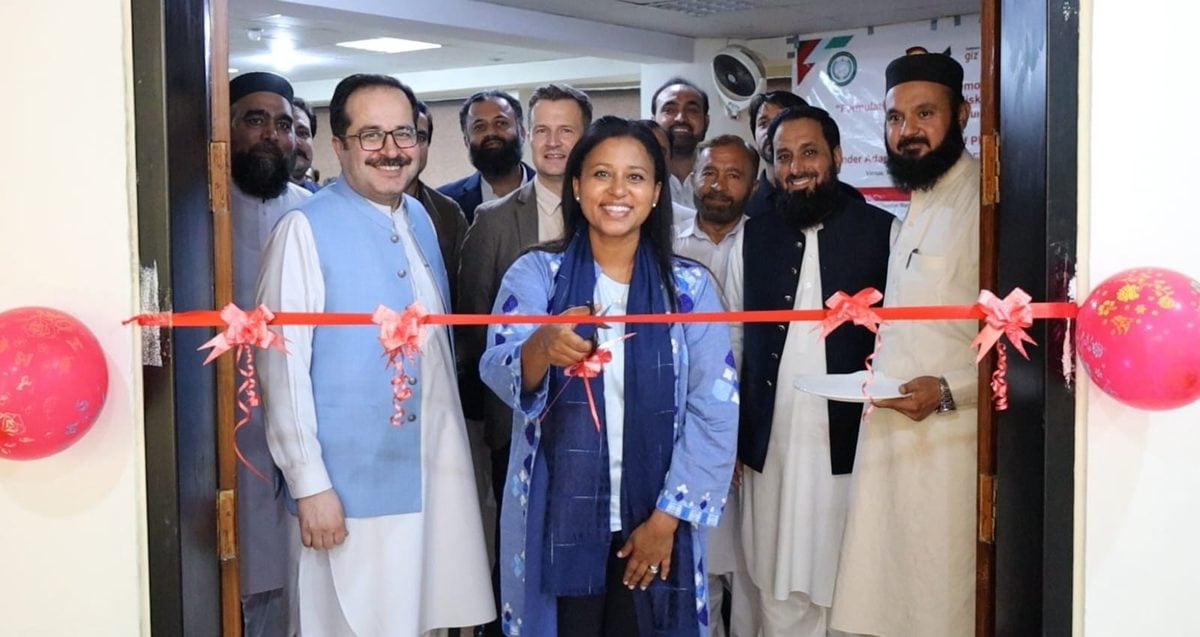
Developing a policy for a province facing such diverse risks could not be done by one institution alone.
In October 2024, PDMA Khyber Pakhtunkhwa established seven thematic working groups to help shape the policy.
Their areas of work ranged from institutional development and hydro-meteorological hazards to earthquakes and landslides, food security and nutrition, climate change adaptation, complex emergencies, risk-informed development and — importantly — Adaptive Social Protection.
The process brought together government departments, technical institutions, development partners, civil society, academia and other stakeholders. Consultations took place at national, provincial and district levels, with community perspectives also incorporated through meetings, policy dialogues, focus group discussions and key informant interviews.
This was more than an exercise in drafting a document.
It was an attempt to connect issues that are too often treated separately.
A flood is not only a disaster-management problem.
It can become a food-security problem.
A damaged road does not just disrupt transport; it can also cut people off from markets, schools and health facilities.
A lost livelihood or crop can become an income problem.
And for a poor household, an income shock can quickly become a poverty trap.
The policy therefore brings these connections into a single framework.
When a disaster threatens a family’s livelihood
One of the most distinctive elements of the policy is its focus on Adaptive Social Protection.
The idea is simple: if governments know which households are vulnerable and have systems capable of reaching them, social protection programmes should not have to wait until a disaster has already pushed a family into crisis. They should respond before the crisis takes hold.
Adaptive Social Protection sits at the intersection of disaster risk management, climate change adaptation and social protection. The policy recognises that shocks can wipe out livelihoods and reverse hard-won gains in poverty reduction and human development.
Imagine a family whose only income comes from farming.
A flood destroys its crop.
Without support, the family may sell its livestock, borrow money, reduce food consumption or withdraw children from school.
But what if the system could identify vulnerable households in advance, connect early warnings with social protection and provide assistance quickly when a predefined trigger is reached?
The family would still face the shock.
But it would have a better chance of surviving it without losing everything.
That is the difference between simply responding to poverty after a disaster and building resilience before it.
The policy proposes using existing social protection payment systems for emergency cash assistance, including electronic payments, because these systems can potentially deliver support more quickly, accurately and transparently.
Making development safer before it is built
The policy also asks a much bigger question:
Are we creating tomorrow’s disaster risks through today’s development decisions?
A road built without considering landslide risks, a settlement expanding into a flood-prone area or infrastructure constructed without adequate hazard assessment can increase exposure for decades.
The policy therefore places risk-informed development at its core.
It calls for disaster and climate risks to be considered in planning and financing, including infrastructure, land-use decisions and sectoral development. Risk assessments are expected to identify vulnerable locations and populations, while scientific data, geospatial tools and local knowledge can be used to build a more detailed understanding of risk.
In this approach, resilience is not something added after a project is completed.
It becomes part of the design.
A school should be safer because it was built with future hazards in mind.
A road should remain usable when extreme weather strikes.
A community should know where to go before floodwaters arrive.
And recovery should not simply rebuild what was destroyed — it should reduce the chance of the same loss happening again.
The people closest to risk are part of the solution
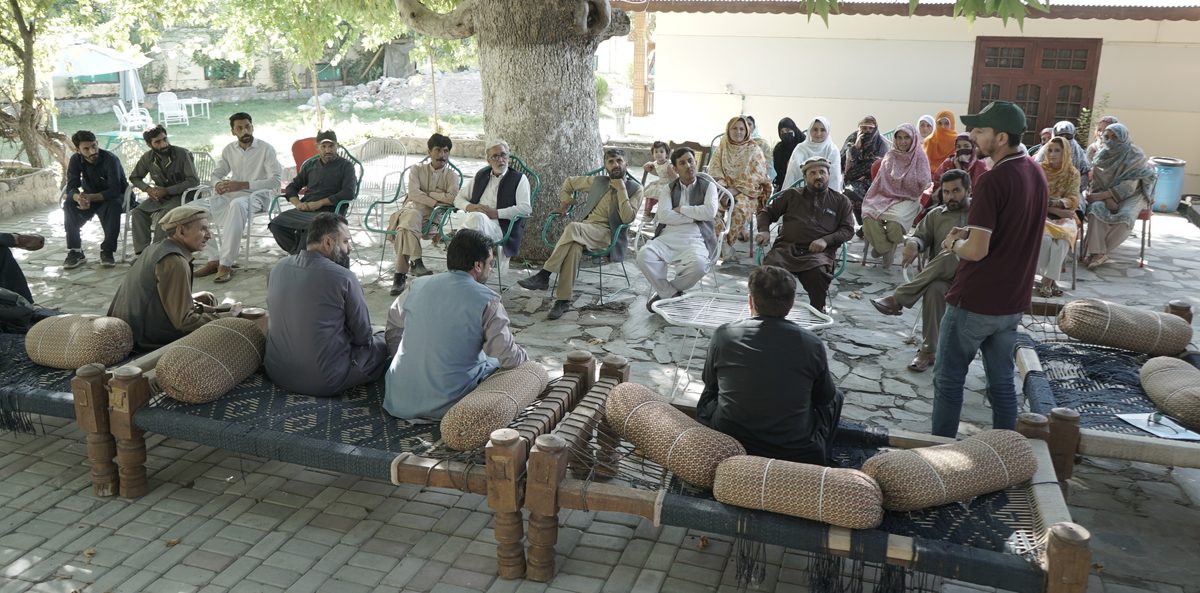
There is another important shift in the policy: communities are not treated simply as recipients of assistance.
They are recognised as the people who are often first to experience a disaster — and often the first to respond.
The policy proposes Community-Based Disaster Risk Management, stronger disaster management structures at the village council level and inclusive Community Emergency Response Teams. Local volunteers, including women and other marginalised groups too often left out of these structures, can be trained and equipped to respond to emergencies and support their communities.
This matters especially in remote parts of the province where an emergency response team may take time to arrive.
A trained neighbour can be there first.
A local warning can reach a household before a national message does.
Local knowledge can identify a dangerous route that may not appear on a map.
Resilience, in other words, starts with people.
A partnership that brings different expertise together
The development of this policy has also demonstrated the value of international cooperation that supports locally led solutions.
The Government of Khyber Pakhtunkhwa, through PDMA, led the policy process. Germany supported this effort through the Federal Ministry for Economic Cooperation and Development (BMZ), with implementation support from GIZ. The policy acknowledges this partnership for strengthening policy formulation and integrating social protection and climate-resilient approaches into the provincial DRR framework.
GIZ’s contribution went beyond financial support. The policy acknowledges the technical and coordination contributions of the GIZ team, including expertise in disaster risk management, social protection, gender and Adaptive Social Protection.
This partnership is significant because it brings together areas that are often addressed through separate programmes: disaster risk management, climate change adaptation and social protection.
The result is a policy that does not see resilience as the responsibility of one department alone.
It connects disaster management with planning, climate change, agriculture, health, nutrition, water, livelihoods, social protection, finance and community action.
From a document to a living system
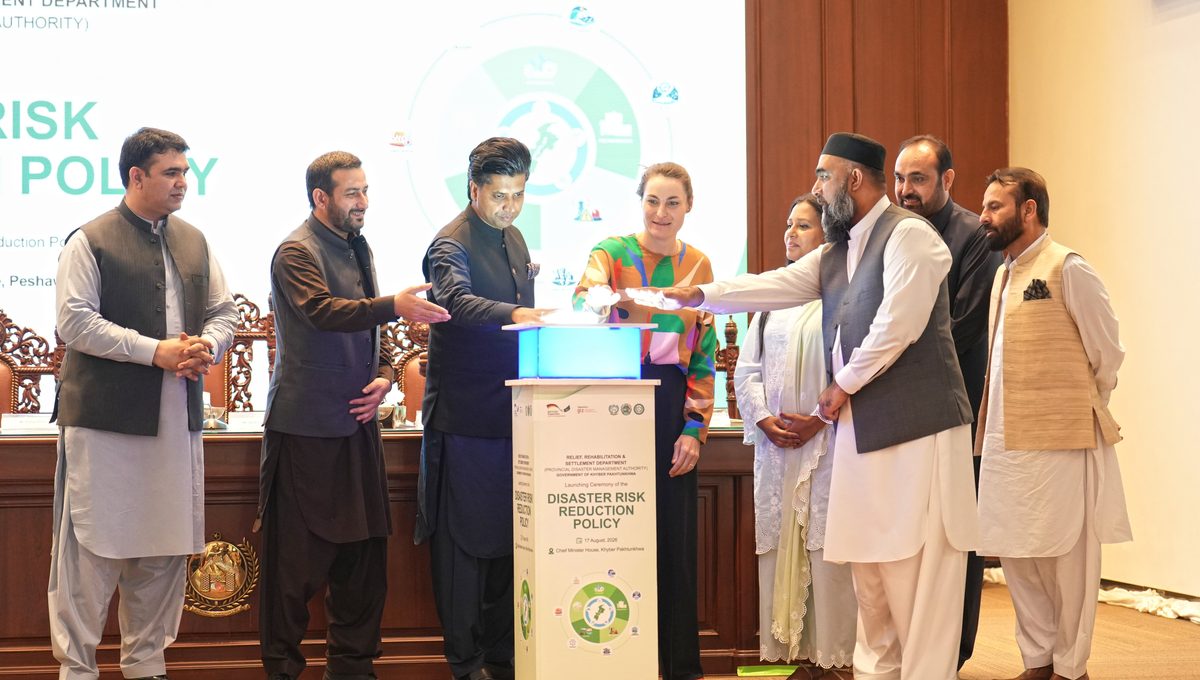
After nearly two years of consultations and technical work, Khyber Pakhtunkhwa’s DRR Policy was approved by the Cabinet on 21 May 2026.
Its public launch in Peshawar on 17 August marked an important milestone.
But perhaps the most important part of the policy is what comes next.
PDMA and District Disaster Management Units will lead implementation at provincial and district levels, while line departments are expected to develop their own sectoral disaster management plans. A Khyber Pakhtunkhwa Disaster Risk Reduction Policy Implementation and Oversight Committee is envisaged to provide strategic oversight and monitor progress. The seven thematic working groups that helped develop the policy are also expected to continue their work through regular meetings and reporting.
The policy also proposes a multi-level implementation system, with provincial and district disaster management plans designed around a ten-year implementation horizon, including a five-year implementation plan for 2027–2032, and consultations extending to communities, civil society and women-led organisations.
This makes the policy more than a statement of intent.
It is intended to become a framework for changing how risk is understood, planned for and financed across the province.
A different way of thinking about disasters
Perhaps the most important change is not a new piece of equipment, a new database or even a new committee.
It is a change in mindset and approach.
For decades, the familiar sequence has been:
The new ambition is different:
That shift could have profound implications for families who have little room to absorb another shock.
The policy itself recognises that it must continue evolving. Its implementation includes monitoring, feedback and learning mechanisms, allowing it to respond to emerging risks, major disasters, technological developments and changing climate realities.
That is important because resilience is not something a province achieves once and then completes.
It is built every time a community is better prepared.
Every time a vulnerable family receives help before selling its last asset.
Every time a school, hospital or road is designed with future hazards in mind.
Every time an early warning leads to action.
And every time recovery leaves people safer than they were before.
Khyber Pakhtunkhwa’s DRR Policy is therefore not simply about preparing for the next disaster. It is about changing what happens before, during and after it — and putting people, their livelihoods and their future at the centre of that change.
With provincial leadership and German support through BMZ and GIZ, a two-year process has produced a framework that brings disaster risk reduction, climate resilience and social protection closer together.
Now comes the harder part.
Turning policy into practice — before the next warning becomes a disaster.
Farman Nawaz
September 2026