

Social assistance ‘on demand’ in Cambodia
Quicker and more flexible than ever, IDPoor is ready to deliver in times of shock
IDPoor interview in Ratankiri Province, June 2020 ©GIZ/Conor Wall
By late May 2020, 78-year-old Sok Tet found himself in an increasingly desperate situation. His family’s food supplies were so low that he and his wife had begun to eat less than usual. Sometimes they had to borrow from neighbors to keep from going hungry. Normally, Sok Tet’s three adult children sent him money every month, but since the COVID-related lockdowns had shuttered the factories where they worked, they could no longer do so.
The Government of Cambodia was fully aware of economic consequences of the pandemic for millions of Cambodians, like Sok Tet, who were abruptly cut off from their normal sources of income. In mid-April the National Social Protection Council announced plans for an unprecedented cash transfer programme and gave the Ministry of Planning just six weeks to update the list of poor and vulnerable households in rural areas who qualified for support. Cambodia’s nascent social protection system was about to face its biggest test.
A massive nationwide effort to identify poor households
What happened next was nothing short of remarkable. In a matter of weeks – under pandemic conditions and without the luxury of time to fully prepare the roll-out – Cambodia introduced a new ‘on-demand’ registration procedure for its national poverty identification system, IDPoor. Households whose economic circumstances had changed, and who wished to be assessed under IDPoor, could register for an interview at their local commune offices.

Over the next four months, more than 210,000 households across Cambodia did exactly that. Eighty-six per cent of them were identified as IDPoor households and received Equity Cards, with which they could register for financial assistance and other social benefits. Sok Tet was among them. On July 2nd, he collected his first cash transfer from a local payment agent and went straight to the market to buy rice.
All eyes on Cambodia as it switches to continuous targeting
The COVID pandemic has shown the benefits of adaptive social protection systems which are able, when shocks hit, to direct support quickly and flexibly to the people who need it. Countries like Cambodia which had existing targeting systems upon which to build were able to mount more effective responses than those which had to build systems from scratch, or which had to rely upon household data that were partial or out-of-date.
Cambodia’s experience in switching from a periodic to on-demand targeting system has attracted attention from other lower and lower-middle income countries which aim to develop these same capabilities. This article describes how Cambodia succeeded in transforming IDPoor, its flagship poverty identification programme, from a system reliant on data gathered via three-yearly sweeps to one in which household data can be continuously updated. It highlights the factors which enabled IDPoor to make this change, as well as the trade-offs which the new on-demand approach entail.
181,000 households impoverished by COVID seek help – and get it, thanks to IDPoor
Between May and September 2020, 181,000 households across Cambodia became newly eligible for social assistance as part of the massive nationwide effort to identify poor and vulnerable families. The majority of these were identified during a single two-week period in late May, when the country’s 1,646 Commune Councils responded to the call from the national government to roll out on-demand IDPoor.
The flexible new identification procedure was developed by Cambodia’s Ministry of Planning, with technical guidance from the IDPoor Support project implemented by the Deutsche Gesellschaft für Internationale Zusammenarbeit (GIZ). The project works in Cambodia on behalf of Germany’s Federal Ministry for Economic Cooperation and Development (BMZ) and the Australian Department of Foreign Affairs and Trade (DFAT).
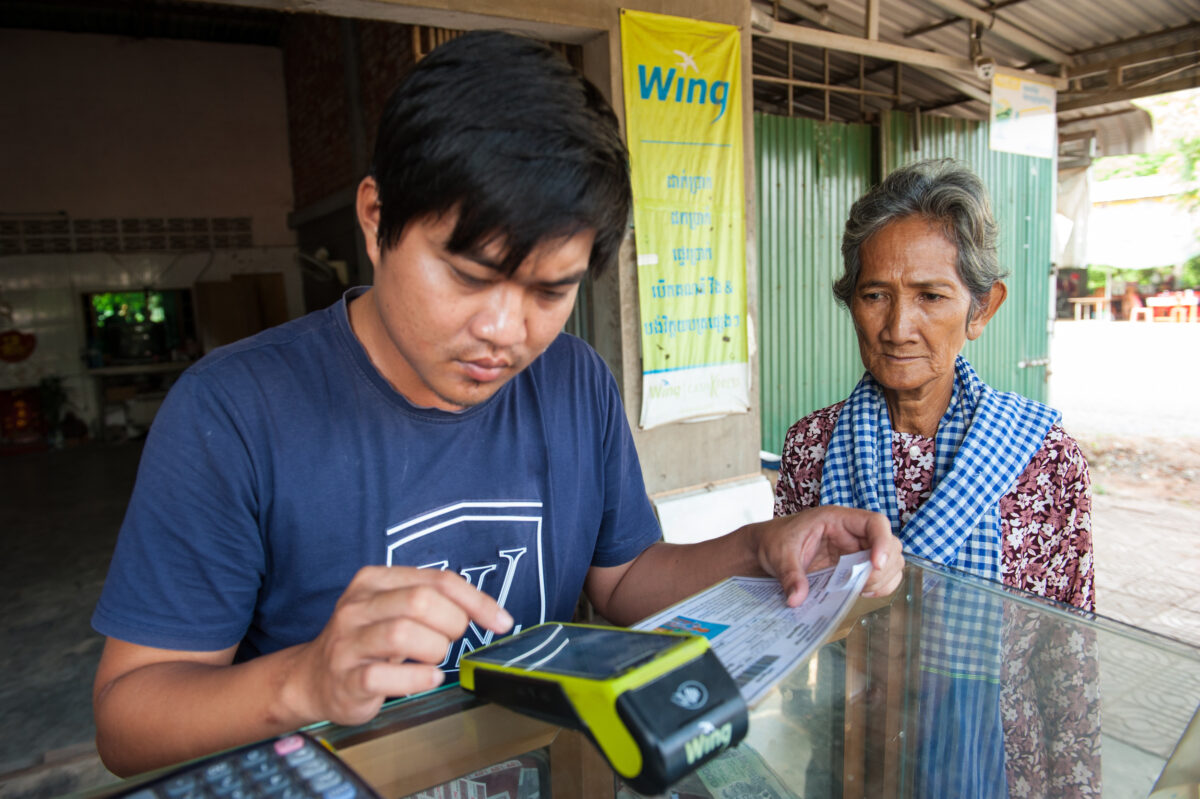
Together with the 508,000 households which were already in the IDPoor registry at the outset of the pandemic, these additional 181,000 households have been benefitting from the largest cash transfer scheme ever enacted in the Kingdom of Cambodia. Since June 25, 2020, when the first payments were issued, the Cambodian government has spent more than 590 million USD on the programme, one of a growing number of social protection schemes which are helping to strengthen the country’s social safety net. As the national system for identifying poor and vulnerable households, IDPoor is essential for making sure that social assistance reaches those who need it.
What are the advantages of on-demand identification systems?
Cambodia is far from alone in enacting social protection measures to help its population weather the economic effects of the pandemic. However the way it has done this – using a flexible, on-demand approach to identify poor and vulnerable households – sets it apart from many other lower and lower-middle income countries.
Dynamic identification is important for accurate targeting. This is because poverty is not a fixed state. Households move in and out of it, and the composition of households changes, too. When data are only collected at fixed intervals every few years, as is the case in many countries, targeting decisions have to be made on the basis of static ‘snapshots’ which may be out of date.
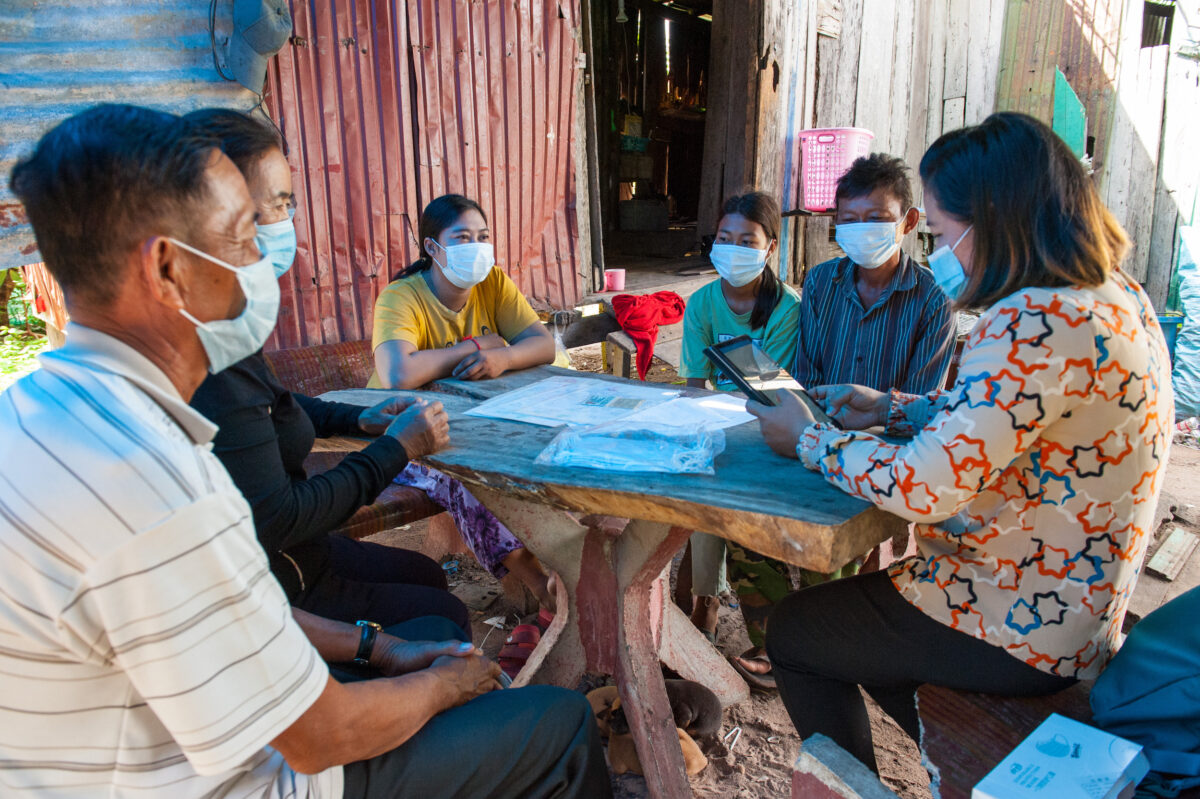
Until recently, this was the case in Cambodia, too. The original IDPoor system, which began in 2007 and combines a household proxy means test with a community-based selection process, identified households via three-yearly sweeps. In between sweeps, if a non-IDPoor household was affected by illness, loss of income, a natural disaster or any other change of circumstance, there was little it could do but wait for the next IDPoor round. Migrant workers posed another pressing challenge: workers who were absent during the IDPoor sweep would be excluded, even if they were eligible for an Equity Card.
‘The idea behind introducing on-demand IDPoor was to establish a complementary mechanism to identify households that fall into poverty between the three-yearly rounds,’ explains H.E. Keo Ouly, the head of the Department of Identification of Poor Households at the Ministry of Planning. ‘Feedback from implementers and service providers indicated how difficult it was for those households to wait for the next round to be identified.’
Early steps towards on-demand identification
In 2017-2018, with support from the IDPoor Support project, the Ministry of Planning piloted an on-demand version of IDPoor in 19 communes. The results were encouraging. The Commune Councils were able to handle the volume of new requests for interviews and were not overwhelmed by a surge in demand when the opportunity to apply for an Equity Card was announced.
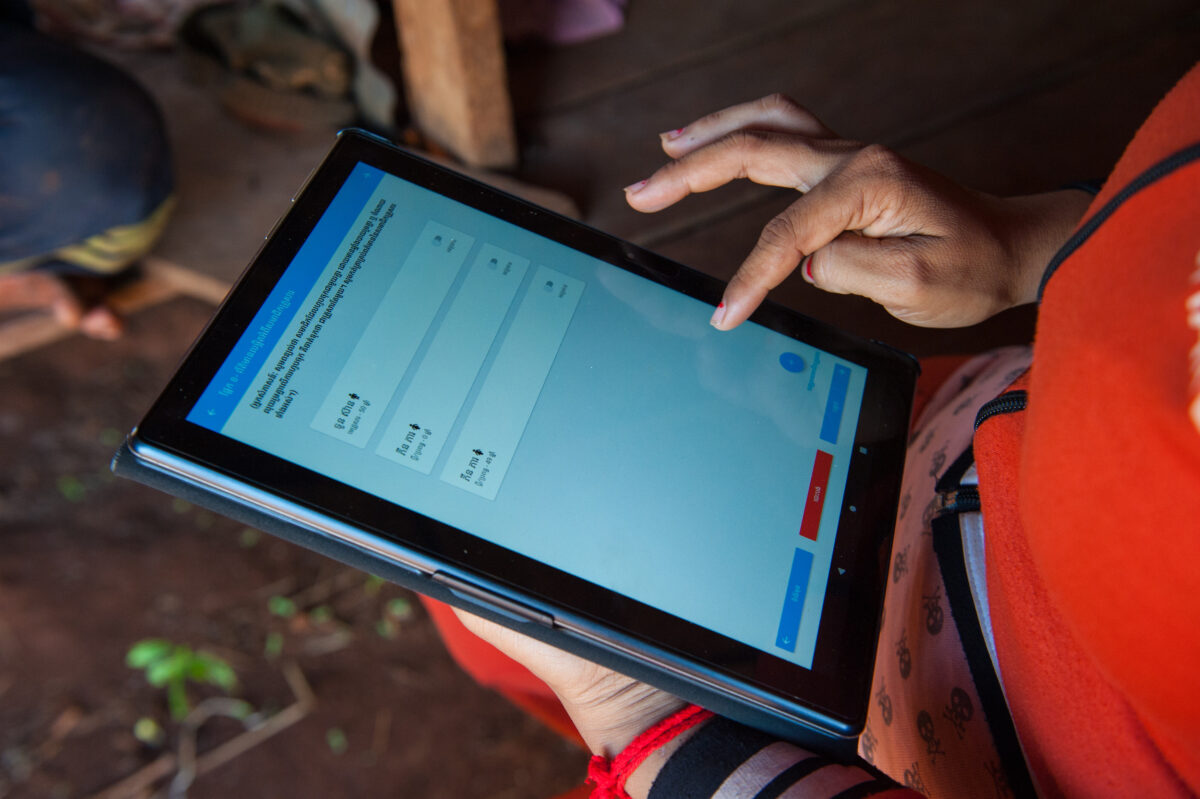
Just as important, they were comfortable using tablets, and a specially programmed IDPoor app, to administer the IDPoor questionnaires and to upload the captured data directly into the national database, rather than using paper forms.
Sabine Cerceau, the technical team lead for GIZ’s IDPoor Support project, remembers the moment when it became clear that the on-demand approach was performing as intended: ‘After an initial peak, the number of interview requests settled down to quite a manageable level in the communes,’ she explains. ‘And then one of the pilot communes was hit by flooding, and we suddenly saw a rapid increase in requests. This showed, without a doubt, that the on-demand approach was working.’

Emboldened by this experience, the Cambodian government decided, in 2019, that it would gradually roll out the on-demand approach – as a supplement to the regularly scheduled sweeps – over a three-year period, starting in 2020. A team at the Ministry of Planning set to work revising the master implementation manual, developing training materials, and upgrading the IT system so that it could manage data updates and share data with user organisations on a continuous basis.
Carefully laid plans are disrupted by COVID
Then, COVID struck and everything changed. Cambodia’s National Social Protection Council, which coordinates the country’s social protection initiatives, announced the new cash transfer programme and gave the Ministry of Planning four weeks to distribute tablets to every commune in Cambodia and to train IDPoor coordinators and implementers in the on-demand approach. The Commune Councils then had two weeks to use the new procedure to identify additional households that had fallen into poverty since the previous IDPoor round and to remove from the registry any families whose situation had improved since the last sweep.
Within a matter of weeks, on-demand IDPoor went live countrywide. The roll-out was not without glitches, but overall it was a spectacular success – so much so that in August 2020 the government announced that there would be no more sweeps: IDPoor would henceforth be fully on-demand.
Commune Councils now facilitate the dynamic updating of data
The IDPoor system had relied upon the three-yearly sweeps not only to identify households, but also to update the information held about them in the national IDPoor database. The sweeps were the chance to record births, deaths, new members who had joined households and those who had moved away. Now, with sweeps a thing of the past, the Department of Identification of Poor Households introduced new functionalities into the IDPoor app to allow for this data to be continuously updated.
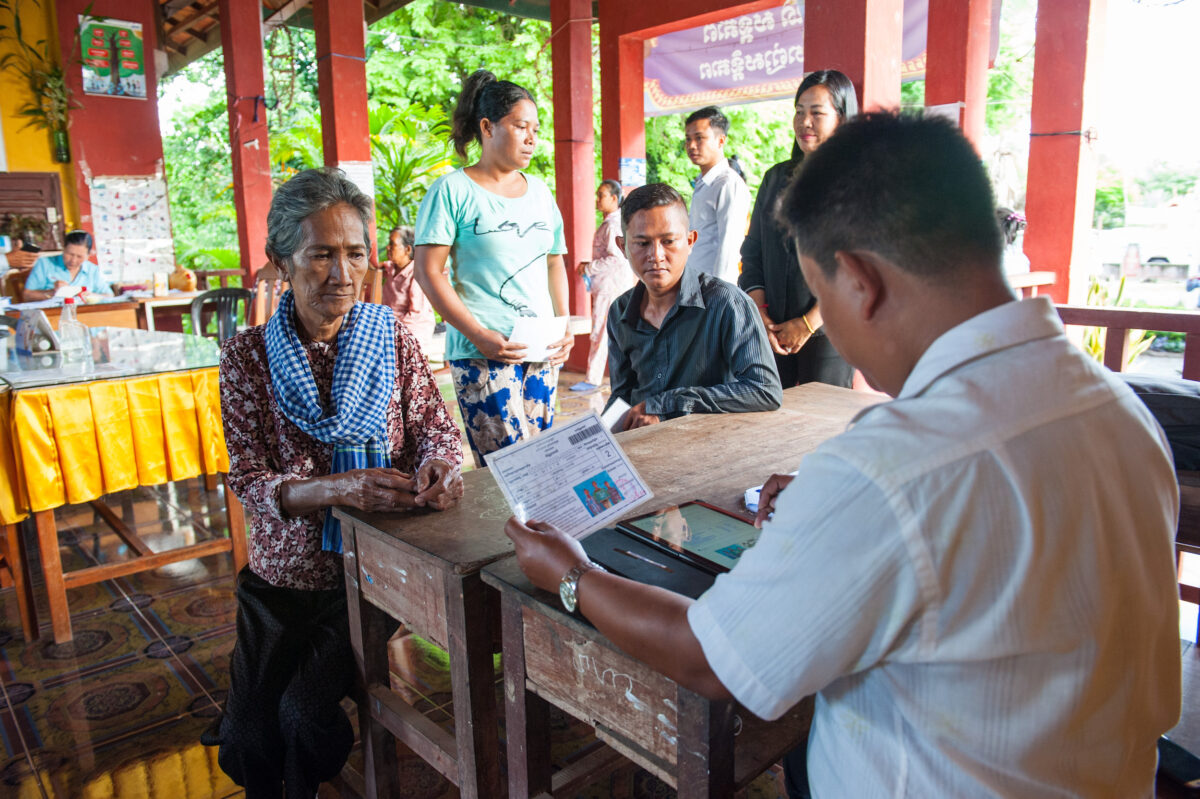
Using the tablets, Commune Councils can now directly update the records of IDPoor households and upload the changes into the national IDPoor database at any time. They can also remove households whose socio-economic situation has improved, for example as a result of new income opportunities.
The IDPoor app automatically notifies Commune Councils before a household’s Equity Card is due to expire, prompting them to schedule an interview with the household.
‘The ability to edit household information on an on-going basis is especially important for service providers,’ explains H.E. Keo Ouly. ‘The amounts paid through the cash transfer programmes, for example, depend on the number of household members. This information needs to be correct.’
Digitalisation enhances accuracy, speed and data quality
The rapid transition to on-demand IDPoor would not have been possible in the absence of a strong digital backbone – the IDPoor app linked to the national database. Not only have these tools made it significantly faster to collect and update information, but the quality of data has also improved.
Digitalisation has made the identification process more accurate and objective, explains Oliver Schell, a CIM integrated expert at the Department of Identification of Poor Households. ‘When they worked with the paper questionnaires, interviewers had to make judgements and manually calculate poverty scores during the interview itself. This was quite complicated,’ he says. ‘Now, they are taken through the relevant parts of the questionnaire and simply input information. The score is calculated automatically and the interviewers don’t even see it.’
Schell is working with his colleagues at the Ministry of Planning on a new approach to monitoring data quality, which will be rolled out this year. Communes will be randomly selected for monitoring visits which will include both process monitoring (Have identification procedures been implemented according to procedure?) and data quality monitoring (Are the right households being identified?). A random selection of IDPoor households and non-IDPoor households will be (re)interviewed to check for inclusion and exclusion errors, respectively.
Last year, when the Department piloted this methodology with 1,000 households, it found that IDPoor had an 86% accuracy rate – a strong performance compared to other countries. ‘Data accuracy is important for the credibility of IDPoor,’ says H.E. Keo Ouly.
Three success factors behind the transition
COVID-19 provided the impetus for the transition to on-demand IDPoor, but several critical preconditions were in place that made the effort successful. First, IDPoor was already well anchored in the Cambodian social protection system, both in law and in practice. A government sub-decree mandates the Ministry of Planning to collect data about poor households and requires organisations which provide pro-poor services to use IDPoor data to identify eligible beneficiaries.
Second, Cambodia was able to draw upon existing local-level administrative capacity, in the form of Commune Councils, to provide the ‘citizen interface’ that is essential for an on-demand system to function smoothly. The Councils were already familiar with IDPoor, as they previously oversaw the three-yearly sweeps in their areas, and were also engaged in identifying beneficiaries for other social assistance schemes, such as those targeting pregnant women and children. It will be necessary to monitor whether the Commune Councils become overburdened by the additional responsibilities; thus far, however, it appears that they have sufficient capacity to handle the continuous registration and updating of household information.

A third success factor was the use of digital technologies. Over many years, IDPoor has invested in the development of both front-end and back-end solutions which enable it to efficiently collect, manage and share data. In developing these systems, however, it has been careful not to outpace existing levels of infrastructure, connectivity and digital literacy in the country. At times, this has meant opting for simpler digital solutions rather than high-tech ones. At the same time, the IDPoor IT team has kept a constant eye to the future and correctly anticipated the eventual need for new functionalities, such as continuous updating and data sharing.
Clear benefits to on-demand – but trade-offs, too
The switch to an on-demand approach will bring greater agility to the delivery of social protection in Cambodia, but there are some inherent drawbacks which need to be watched carefully in the years ahead.
With Commune Councils now in the driver’s seat in terms of the implementation of IDPoor procedures, the participatory element of the approach is somewhat diminished. The hallmark of IDPoor in its previous iteration was the fact that villagers themselves were directly involved in determining who amongst them was poor. Now, they are further removed from the interviewing and validation process. To compensate for this loss of consultation, IDPoor has introduced new measures to enhance transparency. Just as anyone can come forward to be interviewed, so too can anyone register a request for an IDPoor household’s status to be reviewed (i.e. if there is reason to believe that household has assets which disqualify it for IDPoor status). A complaints mechanism is also being put in place.
Another limitation is that on-demand registration systems tend to have lower coverage than systems based on sweeps, one reason being that vulnerable and marginalised populations in particular may not know how to register. Aware of this challenge, the Ministry of Planning is intensifying communication and outreach about IDPoor to raise awareness of the registration process and the services which are available to Equity Card holders. Implementation procedures have also been designed in such a way that village chiefs, community organisations, health facilities and other entities can apply for an interview on behalf of a household, or can assist a household to file a request.
The cornerstone of Cambodia’s evolving social protection system
The COVID pandemic has shown that countries which invest in social protection systems are better able to respond when shocks arise. Cambodia’s ability to roll out a targeted cash transfer scheme nationwide, in a matter of weeks, is a testament to strong political commitment and leadership, but also to years of continuous investment in the IDPoor system, the human resources which implement it, and the IT system which helps it run.

‘On-demand identification is an important element of a shock-responsive social protection system,’ says Sabine Cerceau, of GIZ. ‘Flexible targeting is another.’ IDPoor has begun enhancing its targeting capabilities by improving the quality and breadth of the data which it holds on individual members of households, rather than focusing only on the household as a unit. In the future, this will allow individuals with specific vulnerabilities – related, for example, to their age (e.g. children under the age of five and the elderly) or disability status – to be identified for support.
IDPoor is also poised to enlarge its coverage to include ‘near-poor’ households and those which are particularly vulnerable to climate-related shocks, such as flooding. By collecting information about these households before crises strike, IDPoor would enable the programmes which use its data to direct help to those who need it without having to spend time identifying them first. This is a major milestone on the road to a shock-resistant social protection system which is able to target assistance on the basis of vulnerability, and not only poverty.
Karen Birdsall
March 2022